Mutiny: The Pirate Party Game

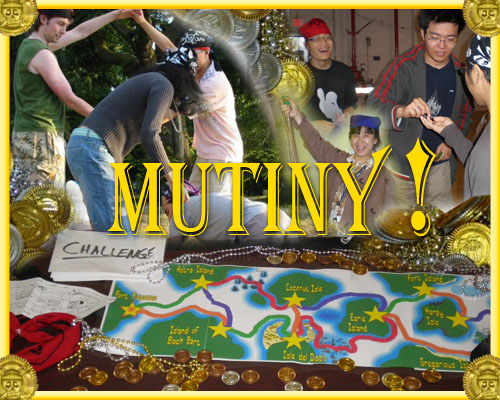
Some friends play-test Mutiny

Some friends play-test Mutiny

Made in 2006

Style: Party Game

Ages: 10+

Inspiration: The Prisoner’s Dilemma

Description: Ever wanted to be a pirate? Well, join the crew of the Lecherous Seagull and find your fortunes! In this party game, crew members are all trying to steal the treasure from the hold while the captain sails the ship and its cargo safely to port. The Captain’s position is a tenuous one though as the crew regularly mutinies against him and try to take control.

The crew’s main challenge is to balance the need for money with the need to make sure the ship gets safely from island to island, successfully overcoming obstacles such as other pirate ships, storms, and the dreaded Kraken!


Challenge:
My biggest challenge has been that while everyone enjoys the mini-game challenges (based off of kid games I learned when growing up). It seems everyone over 18 gets hurt playing them.

Solution: I’m still searching for other active games that aren’t risky and have plans to add a digital element so that digital mini-games could be a part of the fun!


Challenge:
A host is required to guide players through the three phases of each round.

Solution: see the above solution – I’m looking into creating a digital host to lead the game. (i.e. a video)

Europe Trip and the NLGD Festival

Recently I travelled to Europe for four weeks as a post-graduation celebration trip. It was fantastic. I had a good mix of adventure and touristy visits. Everything from Museums to biking through small towns of France, to visiting friends in Berlin, and meeting new friends along the way. Most importantly though, I got to attend the Netherlands Game Developers Festival (or NLGD Festival).

It was an amazing conference that had a large focus on Alternate Reality Games and Urban Games. It was fun and I even got to attend the Game Design session that spanned two of the afternoons. One for design, one for play. My partners and I got to take home the trophy for “Most Played” game. It was very neat to see what was happening abroad as far as games. Netherlands also has a large serious games community developing games that teach you everything from English to Project Management.

It was quite a bit smaller than GDC, but had an enthusiastic group of developers attending.

Museum of Musical Instruments

One other worthy mention for my trip was the Museum of Musical Instruments in Brussels, Belgium. This is a great example of a smart use of digital media. In the Museum they give you wireless headphones to wear. You walk in and find cases upon cases of musical instruments. When you walk up to each case you suddenly hear the sound of the musical instrument in front of you. As you walk around the room the music changes to each instrument, so you spend the next few hours wandering around hearing music of all varieties. A strange experience is to quickly walk down an aisle and hear the music rapidly change from Classical to bagpipes to rock to drums to panpipes all in the course of a few seconds.

I would love to use that technology for a real-world game.

AI Conference & GDC Whirlwind

So last week I had the great fortune to not only present an Artificial Intelligence paper at Stanford on behalf of my Summer Internship Employer but also to attend a little of the Game Developer’s Conference in San Francisco.

The AI Conference
The conference I was presenting it at was the AAAI Symposium and had lots of interesting people. Including a professor working on a story system called Twig which allows you to direct the characters and create scenes using structured english. It was quite neat – especially when he setup his Monty Python sketch.

The paper I presented was about using evolutionary fuzzy cognitive maps in creating believable characters for telling stories in virtual worlds. It took the idea of fuzzy cognitive maps, where a collection of entities or concepts have relationships that impact each other, and added the random probabilities of Bayesian Networks. The author of the paper is in Singapore and was not able to get a visa in time for the conference, so with one week to go they quickly gave me a call and I happily agreed to help them out.

GDC
The day after I headed north from Stanford to San Francisco and roomed with other friends who were attending GDC. I only had Tuesday available but I made the most of it by attending the Canadian-Dutch Breakfast, taking a tour of Three Rings Studio, and attending some evening networking events.

Canadian-Dutch Breakfast
The Dutch Breakfast was excellent I met some exciting entrepreneurs. This was very valuable for me as I am looking to work in the Netherlands for a change of pace. I really would like to see what working in Europe would be like and the Netherlands is my preferred place in Europe to be.

Combustic is being founded by a passionate developer looking to bring more digital media to the real world. I really liked the ideas he brought forward and am wanting to learn more.

ranj designs serious games. Getting to talk with one of the heads of the company in a booth was amazing. GAF showed me their game for aiding Dutch People to get used to speaking English and using it in public places. He also showed me their award winning Shark-world: an innovative game that gets players used to working as a project manager and dealing with the day to day troubles that a project manager has to work with. It even has some Alternate Reality Game elements when you get texted by the game on your cellphone! These are games I would love to work on.

Three Rings Tour
Later when I went to Three Rings I must admit that I was so excited to be exploring a company’s headquarters that looked like a pirate ship! It was very cool! I’m a big fan of Puzzle Pirates and have played it for many years. Their Whirled version of their office is cool, but doesn’t do the full justice of how mind-blowingly great the office really is! (They have a secret room!) And to be able to listen to Daniel James, the CEO and designer of Puzzle Pirates, tell about the history of Three Rings was awe-inspiring.

StarCatcher Game

Make sure your sound is on.

Goal: Collect the stars and guide them safely to the lamps (white objects on the bottom of the level).

This really needs a tutorial level. So, as a reminder:

Goal: Collect the stars and guide them safely to the lamps (white objects on the bottom of the level).

Avoid the Black clouds which will destroy your stars.

Finally, You get more points if you’re carrying more stars when you light the lamps.

Global Game Jam

Two weekends ago I participated in the Global Game Jam along with some fellow students at the MDM program. We all spent 48 hours working with other game design enthusiasts around the world making games.  You can check out the games at globalgamejam.org The team I forged with created a game called “Slast” using the Unity Engine.  For most of us on the team that meant we were learning an engine and creating a game at the same time.  I used the time to do some scripting for the spikes as well as getting a chance to step out of the programmer role and try some 3D Modelling and art.  It was quite fun and I liked designing it alongside the modeller who did the Giant Spider.  Keep in mind the name of our group when you play it as none of us were real artists on the team, but we still came up with something decent.

As far as Unity goes, I would definitely use it again sometime.  It is quite handy and has lots of features.  I’ve used the Blender open source game engine and would say that Unity is better than Blender since the interface is unified (a lot of the shortcut keys are similar to Maya) and it exports so well to many interfaces.